As a reminder, this game is in ABC's 3:30 ET slot which means regional and/or mirrored coverage for most of the country. If you're on the East Coast you should be able to watch on ABC. Anywhere else will have to check their local listings...OR if you are near a local Game Watch, you could watch with fellow BC fans! There are new locations for the always popular Chicago and New York City watches. If you Chapter is having a Watch and it is not listed, please post the info in the comments section and send me an email.
Chicago Game Watch **NEW LOCATION**
Tripoli Tap
1147 West Armitage Avenue
Chicago, IL 60614
(773) 477-4400
Dallas Game Watch
Christies Sports Bar
2811 McKinney Avenue
Dallas, TX 75204-8567
(214) 954-1511
New Jersey Game Watch
O'Hara's Downtown
172 First St.
Jersey City, NJ
New York City Game Watch **NEW LOCATION**
Joshua Tree (on 3rd Avenue btw 34th and 35th Streets).
The bar is going all out for the BC crowd. There will be beer and food specials, raffle prizes
and a BC flag outside bar.
Phoenix Game Watch
Gallagher's Sports Grill
7575 N. 16th Street
Phoenix
San Diego Game Watch
The Beer Company
602 Broadway
San Diego, CA 92101
San Francisco Game Watch
Shanghai Kelly's in San Francisco
2064 Polk Street (corner of Polk and Broadway)
San Francisco, CA 94109
Washington, DC Game Watch
Irish Whiskey Public House (formerly Porter's)
1207 19th Street, NW
Washington, DC
Friday, August 31, 2012

Thursday, August 30, 2012
BC-Miami preview
A new season. A new start. That's what we get on Saturday. People talk about the wins trending down the past few seasons, but the fun around BC football has also slid. I desperately want that to end. Winning would be nice. But I'll settle for some exciting games and playing to win. We fans think we deserve it. I know the players deserve it. I don't expect a classic game on Saturday but the teams match up well enough that it could be fun again.
**NEW FEATURE** Hot Seat Thermometer
In college football every game is a must win, but even more so when you hold the hottest seat in the sport. Each week I will be rating Spaz's seat depending on the game, the opponent, the pressure and the fanbase's mood. This week is very important. A win can set the tone for the entire season and set BC back on a path to the postseason. A loss will dampen the mood everywhere around the team.
Temperature: toasty
Overlooked storyline: rivalry renewed?
BC played Miami annually until we followed them into the ACC. Of course our "partner" was slotted in the other division meaning we only play them on a cross-divisional schedule. However, with the ACC expanding there is still a chance that the divisions could be shuffled. I hope that whatever new pairings come down, that the ACC tries to honor some of the old Big East matchups.
Three simple keys
1. Tempo. We've heard about changes in tempo before. Now I want to see it. If we expect to beat anyone this year, scoring less than 20 points a game is not going to do it. To improve scoring we need to move faster and create more possessions and opportunities.
2. Get to Morris. One of the reasons BC had success against Miami last year was the pressure we put on Harris. Morris is a different QB, but forcing him to rush throws is the key to slowing their offense.
3. A big day for Rettig. Rettig started really well against Miami last year. He needs to build off of that momentum this game.
Gambling Notes
-- BC has never beaten Miami in back-to-back seasons
-- Spaz is 0-3 in his ACC openers
-- Spaz is 2-1 in home openers
The current line is BC+2
Factoid
This is the earliest in the season that BC has played Miami. Prior to this game, the earliest the date the two teams played was September 4, 1993.
Scoreboard watching
All the ACC games are important but I will be following TOB and NC State. Although Tennessee is down, this is still a big game for the ACC. We need the old Marine to show up on a national stage.
I hope to see...
Andre Williams have a big game. His "comeback" has been a big preseason storyline. We know he has the power, but can he get a good feel for his holes and blocking. Is he healthy? We will see on Saturday.
BC is in trouble if...
The offensive line still struggles. The collapse of the oline has been one of the root causes of Spaz's problems. The talent is there. Now we need to execute.
Bottom line
I think Doug Martin is going to make an immediate impact. I think the offense comes out smoking and the defense contains Miami. I don't know what it will mean for the season, but it will feel nice to have some fun again.
Final Score: BC 31, Miami 14
**NEW FEATURE** Hot Seat Thermometer
In college football every game is a must win, but even more so when you hold the hottest seat in the sport. Each week I will be rating Spaz's seat depending on the game, the opponent, the pressure and the fanbase's mood. This week is very important. A win can set the tone for the entire season and set BC back on a path to the postseason. A loss will dampen the mood everywhere around the team.
Temperature: toasty
Overlooked storyline: rivalry renewed?
BC played Miami annually until we followed them into the ACC. Of course our "partner" was slotted in the other division meaning we only play them on a cross-divisional schedule. However, with the ACC expanding there is still a chance that the divisions could be shuffled. I hope that whatever new pairings come down, that the ACC tries to honor some of the old Big East matchups.
Three simple keys
1. Tempo. We've heard about changes in tempo before. Now I want to see it. If we expect to beat anyone this year, scoring less than 20 points a game is not going to do it. To improve scoring we need to move faster and create more possessions and opportunities.
2. Get to Morris. One of the reasons BC had success against Miami last year was the pressure we put on Harris. Morris is a different QB, but forcing him to rush throws is the key to slowing their offense.
3. A big day for Rettig. Rettig started really well against Miami last year. He needs to build off of that momentum this game.
Gambling Notes
-- BC has never beaten Miami in back-to-back seasons
-- Spaz is 0-3 in his ACC openers
-- Spaz is 2-1 in home openers
The current line is BC+2
Factoid
This is the earliest in the season that BC has played Miami. Prior to this game, the earliest the date the two teams played was September 4, 1993.
Scoreboard watching
All the ACC games are important but I will be following TOB and NC State. Although Tennessee is down, this is still a big game for the ACC. We need the old Marine to show up on a national stage.
I hope to see...
Andre Williams have a big game. His "comeback" has been a big preseason storyline. We know he has the power, but can he get a good feel for his holes and blocking. Is he healthy? We will see on Saturday.
BC is in trouble if...
The offensive line still struggles. The collapse of the oline has been one of the root causes of Spaz's problems. The talent is there. Now we need to execute.
Bottom line
I think Doug Martin is going to make an immediate impact. I think the offense comes out smoking and the defense contains Miami. I don't know what it will mean for the season, but it will feel nice to have some fun again.
Final Score: BC 31, Miami 14
Season Prediction Part III: what will happen
I am a believer in Chase Rettig. I like what Doug Martin brings to the offense and the program. I think there is more talent on defense than people realize. Yet I don't have faith in the man in charge. Readers criticize me for kicking Spaz while he's down or for spreading too much pessimism. That's not my intention. I just think back to multiple games last year that turned on coaching decisions. Was it bad luck? Bad coaching? I don't know. But I don't think it will all be fixed by a few staff changes and Spaz being another year wiser. As I said in the best case scenario, there are still a lot of good pieces on this team. The schedule is manageable. The ultimate question is can we get out of our own way? [This is my official prediction for the season.]
What will happen
Miami. Win. I think this will be a low scoring defensive game. I give BC the edge with Rettig making some big passes down the stretch.
Maine. Win. No underdog scare. BC controls fairly comfortably.
at Northwestern. Loss. This is one of those games where I think coaching will become a factor. We're on the road against a team that can put up points and we waste too many opportunities.
Clemson. Loss. I think this will be a lot like the Northwestern game in that BC can't keep up in a shoot out only this time against a better offense.
at Army. Win. A solid performance that gets us back above .500 and thinking bowl game.
at Florida State. Loss. I expect Florida State to be a Top 5 team at this point. I think we will give them a tough game but not have enough to pull out a win.
at Georgia Tech. Loss. I think their offense will cause us problems. Unlike the other shootouts, I actually think we can score on Georgia Tech. I predict it will come down to coaching and Paul Johnson will make a call that changes the game in their favor.
Maryland. Win. In every scenario I see us beating Maryland. I think we will pound it again and I think they will really struggle to score on us.
at Wake Forest. Win. Even though Wake is in a down cycle, this is a nice win for the program and Rettig. Getting a W on the road when the season is still teetering provides a nice confidence boost.
Notre Dame. Loss. We play them hard (as usual) but lose on some big special teams plays. Dropping to 0-4 against the Irish hurts Spaz with the casual BC fan.
Virginia Tech. Loss. I think this game is close and Spaz goes ultra conservative, but the Hokies hang on.
at NC State. Loss. I fear the team will check out at this point and NC State will still have a lot to play for.
That leave BC 5-7 (3-5) and at home during bowl season. The new Athletic Director fires Spaz shortly after the NC State game and we begin anew.
Wednesday, August 29, 2012
Washington Q&A and other links
BC Draft dusted off the cobwebs to post an interview with DLine coach Al Washington. What I appreciate about Washington is his positive outlook. Someone needs to be the believer and motivator and a young coach not that far removed from playing at BC can be that guy.
There was a flash mob in support of BC's Pete Frates.
BC unveiled its 2012-2013 commercial. They are going with the "birthday" theme. I'm glad they got Chris O'Donnell and Matty Ice involved but I don't know how the sesquicentennial theme will play to potential BC students.
The line has swung to Miami's favor. Read into that what you will.
Spaz admitted that the depth chart is not set in stone.
The basketball team traveled from Madrid to Valencia.
We need a big year from Kasim Edebali.
There was a flash mob in support of BC's Pete Frates.
BC unveiled its 2012-2013 commercial. They are going with the "birthday" theme. I'm glad they got Chris O'Donnell and Matty Ice involved but I don't know how the sesquicentennial theme will play to potential BC students.
The line has swung to Miami's favor. Read into that what you will.
Spaz admitted that the depth chart is not set in stone.
The basketball team traveled from Madrid to Valencia.
We need a big year from Kasim Edebali.
SI hits the nail on the head
 |
| This picture is going to get a workout this season. |
SI posted their season predictions. Most of their analysts expect Spaz to be fired. Mallory Rubin summed it up best:
A two-win season won't cool the nation's warmest butt. Sometimes promoting from within doesn't work. And sometimes it takes four seasons to admit it.
Guest Blogger: Sebastian's Pub
Although our last game was also against Miami, enough has changed in Coral Gables that I decided to reach out again to Hurricanes blogger Vishnu Parasuraman answer a few questions. Vishnu made his name shooting holes in the Yahoo! Sports report on Miami. Now he's back to get us up to speed on the new roster and assess Year 2 of Al Golden.
ATLEagle: The offense is replacing most of its starters, but has a QB in Stephen Morris that has played. How will things be different? What do you expect Miami to try to do against BC?
VP: The offense should be much more run heavy. Last year, when Miami needed key conversions in short yardage, they were unable to consistently run the ball. Instead, they relied on a short, accurate passing game. Stephen Morris has played some, and he has shown a very strong arm but does have the tendency to spray the ball a bit. The goal for Miami will be to rely on a strong, consistent running game. If that happens, then they can use Morris from positions of strength, where he can make big plays out of the passing game. He has the arm to make all the throws, but he might not be able to be consistently accurate. Last year, it was pass to set up the run, this year, that script should be flipped.
ATLEagle: Last season's defense was mediocre and only returns five starters. Do you expect much improvement? Who will be the difference maker? How much of a loss was Ray Ray Armstrong?
VP: I think mediocre was likely too much of a superlative to describe last year's defense. Save a few games, they had all sorts of trouble simply forcing the other team off the field. There were several games where it seemed like the other team didn't punt. Obviously, Chase Rettig torched the secondary last year. He wasn't the only QB to have that kind of success. I do expect some improvement as familiarity with the defensive schemes increases. The Miami defense had essentially been running the same system since Jimmy Johnson was the head coach in the 80s, so overhauling it was certainly a drastic step. There are a few key players to watch. 2 sophomores that had big freshman years are expected to break out: Defensive End Anthony Chickillo and Linebacker Denzel Perryman. They are clearly the most talented players on the defense. Ray Ray is a loss because of his experience, but he never lived up to the hype he had as a recruit. Also, in total, he was suspended for 5 games last year, so the team should be comfortable playing without him. I feel bad for him on a personal level, because I wanted him to have another opportunity to get his career where it was supposed to go before he got to Miami, but as a football loss, I don't know that it will impact the team too much.
ATLEagle: With Al Golden entering Year 2, what is your opinion of him and the direction of the program? Last year was unique in that it was his first season and their was the huge distraction because of the Shapiro scandal. What are you minimum expectations for this season?
VP: I am a big fan of Al Golden. Obviously, when he was hired, we all thought he would be rebuilding a program that was stuck in a rut. No one knew what was about to land on his doorstep. And the school is really lucky they hired him, because he is a top notch character guy and someone that they are very lucky to have as the face of the program through this mess. From a football standpoint, I think the first year was disappointing record-wise. But, I thought the team played a lot better than the 6-6 record. There were several close losses, and obviously, with all the off field stuff, I think Golden did a great job keeping them motivated. Overall, I was happy with his first year. Not happy enough to give him the 8 year contract extension that Miami did, but happy nonetheless. This year, I think it is important that the record improves from a perception standpoint. Miami lost a lot of key players, so it will be difficult. But I felt the team was much better than 6-6 last year, so I would expect 7 or 8 wins for the season to be successful.
ATLEagle: What's your prediction for the game?
VP: Well, this is a tough one. Last year's game is still fresh in my memory. I thought Miami would win last year, and not only did they lose 24-17, but that score was horribly misleading. BC completely dominated the game. And I hate opening the season with a conference road game. I do like the talent and balance of the Miami squad, but there are so many unknowns, it is hard to feel confident. On the other hand, it seems like BC's entire team has gotten injured. I am sure they would also rather open with a directional school. I really like Miami's special teams. I think there a couple of players that can make big plays in the return game, and both the kicker and punter return from last year. I look for that to make the difference and Miami to win by a FG.
ATLEagle: The offense is replacing most of its starters, but has a QB in Stephen Morris that has played. How will things be different? What do you expect Miami to try to do against BC?
VP: The offense should be much more run heavy. Last year, when Miami needed key conversions in short yardage, they were unable to consistently run the ball. Instead, they relied on a short, accurate passing game. Stephen Morris has played some, and he has shown a very strong arm but does have the tendency to spray the ball a bit. The goal for Miami will be to rely on a strong, consistent running game. If that happens, then they can use Morris from positions of strength, where he can make big plays out of the passing game. He has the arm to make all the throws, but he might not be able to be consistently accurate. Last year, it was pass to set up the run, this year, that script should be flipped.
ATLEagle: Last season's defense was mediocre and only returns five starters. Do you expect much improvement? Who will be the difference maker? How much of a loss was Ray Ray Armstrong?
VP: I think mediocre was likely too much of a superlative to describe last year's defense. Save a few games, they had all sorts of trouble simply forcing the other team off the field. There were several games where it seemed like the other team didn't punt. Obviously, Chase Rettig torched the secondary last year. He wasn't the only QB to have that kind of success. I do expect some improvement as familiarity with the defensive schemes increases. The Miami defense had essentially been running the same system since Jimmy Johnson was the head coach in the 80s, so overhauling it was certainly a drastic step. There are a few key players to watch. 2 sophomores that had big freshman years are expected to break out: Defensive End Anthony Chickillo and Linebacker Denzel Perryman. They are clearly the most talented players on the defense. Ray Ray is a loss because of his experience, but he never lived up to the hype he had as a recruit. Also, in total, he was suspended for 5 games last year, so the team should be comfortable playing without him. I feel bad for him on a personal level, because I wanted him to have another opportunity to get his career where it was supposed to go before he got to Miami, but as a football loss, I don't know that it will impact the team too much.
ATLEagle: With Al Golden entering Year 2, what is your opinion of him and the direction of the program? Last year was unique in that it was his first season and their was the huge distraction because of the Shapiro scandal. What are you minimum expectations for this season?
VP: I am a big fan of Al Golden. Obviously, when he was hired, we all thought he would be rebuilding a program that was stuck in a rut. No one knew what was about to land on his doorstep. And the school is really lucky they hired him, because he is a top notch character guy and someone that they are very lucky to have as the face of the program through this mess. From a football standpoint, I think the first year was disappointing record-wise. But, I thought the team played a lot better than the 6-6 record. There were several close losses, and obviously, with all the off field stuff, I think Golden did a great job keeping them motivated. Overall, I was happy with his first year. Not happy enough to give him the 8 year contract extension that Miami did, but happy nonetheless. This year, I think it is important that the record improves from a perception standpoint. Miami lost a lot of key players, so it will be difficult. But I felt the team was much better than 6-6 last year, so I would expect 7 or 8 wins for the season to be successful.
ATLEagle: What's your prediction for the game?
VP: Well, this is a tough one. Last year's game is still fresh in my memory. I thought Miami would win last year, and not only did they lose 24-17, but that score was horribly misleading. BC completely dominated the game. And I hate opening the season with a conference road game. I do like the talent and balance of the Miami squad, but there are so many unknowns, it is hard to feel confident. On the other hand, it seems like BC's entire team has gotten injured. I am sure they would also rather open with a directional school. I really like Miami's special teams. I think there a couple of players that can make big plays in the return game, and both the kicker and punter return from last year. I look for that to make the difference and Miami to win by a FG.
Tuesday, August 28, 2012
Basketball picks up a win in Spain
The basketball team bounced back from their Monday loss, to defeat Real Canoe Madrid on Tuesday. If you watch the clip above it will reinforce many of the stereotypes you probably have about European basketball. It doesn't look like anyone is playing defense. But I love the way BC moved the ball. There is a crispness and a pace that shows how far the young guys have come. I think when ACC play begins, we will be much improved and finally play at Donahue's desired tempo. I also like that we held them scoreless for more than six minutes. That sort of defensive commitment is key to improvement this year.
Ryan Anderson posted his second blog for BCeagles.com and Dennis Clifford wrote his second blog for the Heights.
Season Prediction Part II: best case scenario
This team should be better than expected. If TOB or Jags were still around, I know we would surprise people, challenge for the division and certainly go bowling. I don't feel that way about Spaz. I don't trust him to have the team ready (look at our past starts) nor do I trust him to lead BC to victory in tight games. Still, the schedule is not overly tough. I think Rettig is due for a break out and I think our Defense will be very good. If Spaz doesn't get in his own way, if we get a few lucky bounces and if a few key guys finally reach their potential, this is how the season could play out.
Best Case Scenario
Miami. Win. The 'Canes are hurting as much, if not more than we are. We are better than we were last November and they are worse. Plus it is at home. We win comfortably.
Maine. Win. Never in doubt. All the QBs get to play in a BC romp.
at Northwestern. Win. This games makes up for one of Spaz's most frustrating losses from 2011. This time BC is ready for their offense and slows them down most of the game.
Clemson. Win. This is a shocker and catches the college football world by storm. BC steals the game by forcing multiple turnovers. The team enters the top 25.
at Army. Win. BC has some trouble staying focused following the huge upset of Clemson. The game is sloppy, but we hold on for the win.
at Florida State. Loss. Because of the teams' rankings and records, this becomes a prime time national game. FSU proves to be too much and hands BC its first loss of the season.
at Georgia Tech. Loss. Like BC, Georgia Tech comes into the game ranked and one of the surprises of the season. BC has fits with their offense and losses two in a row.
Maryland. Win. The Terps come to town at just the right time. Rettig has a strong day and BC shuts out their offense. This ends BC's skid. BC is now bowl eligible again.
at Wake Forest. Win. Although struggling on the season, Wake Forest still gives us a game. We hold on and get back into the rankings.
Notre Dame. Loss. This is the game that empties out the Spaz bandwagon. We lose an ugly game to the Irish as they run up the score and we look lost.
Virginia Tech. Loss. It is a sloppy, ugly game. Neither team plays well. Virginia Tech makes fewer mistakes and wins. This ends any hope BC had of winning the division.
at NC State. Win. With Gene out of the picture, the pressure to beat TOB not what it was, but Spaz still ends the regular season on a high note.
This leaves BC 8-4 (5-3). Not elite, but certainly better than last year. BC gets invited to the Belk Bowl and loses to Cincinnati. The new AD has seen enough and Spaz is "retired," gets all the money owed to him and some ceremonial role with the school for a few years.
Best Case Scenario
Miami. Win. The 'Canes are hurting as much, if not more than we are. We are better than we were last November and they are worse. Plus it is at home. We win comfortably.
Maine. Win. Never in doubt. All the QBs get to play in a BC romp.
at Northwestern. Win. This games makes up for one of Spaz's most frustrating losses from 2011. This time BC is ready for their offense and slows them down most of the game.
Clemson. Win. This is a shocker and catches the college football world by storm. BC steals the game by forcing multiple turnovers. The team enters the top 25.
at Army. Win. BC has some trouble staying focused following the huge upset of Clemson. The game is sloppy, but we hold on for the win.
at Florida State. Loss. Because of the teams' rankings and records, this becomes a prime time national game. FSU proves to be too much and hands BC its first loss of the season.
at Georgia Tech. Loss. Like BC, Georgia Tech comes into the game ranked and one of the surprises of the season. BC has fits with their offense and losses two in a row.
Maryland. Win. The Terps come to town at just the right time. Rettig has a strong day and BC shuts out their offense. This ends BC's skid. BC is now bowl eligible again.
at Wake Forest. Win. Although struggling on the season, Wake Forest still gives us a game. We hold on and get back into the rankings.
Notre Dame. Loss. This is the game that empties out the Spaz bandwagon. We lose an ugly game to the Irish as they run up the score and we look lost.
Virginia Tech. Loss. It is a sloppy, ugly game. Neither team plays well. Virginia Tech makes fewer mistakes and wins. This ends any hope BC had of winning the division.
at NC State. Win. With Gene out of the picture, the pressure to beat TOB not what it was, but Spaz still ends the regular season on a high note.
This leaves BC 8-4 (5-3). Not elite, but certainly better than last year. BC gets invited to the Belk Bowl and loses to Cincinnati. The new AD has seen enough and Spaz is "retired," gets all the money owed to him and some ceremonial role with the school for a few years.
Monday, August 27, 2012
Depth Chart released, overreaction ensues
BC released its Game Notes and Depth Chart for the Miami game. I'll get to the depth chart in a moment, but the first thing you should do is read the game notes. Learn them. Memorize them. Turn them into a drinking game, because you'll be hearing them all year from each new announce team!
The actual Depth Chart created a sense of unease on the BC message boards and blogs. Seeing the team on paper put our perceived depth and talent issues all out in the open. We will be starting players in entirely new positions and throwing true freshmen in some critical situations. There was also the curious demotion or two that always makes you wonder if Spaz is using the depth chart to send a message. I try not to read too much into any of it. The best players will get on the field eventually. We don't have an abundance of talent, so if you can contribute, you'll play. When I looked at the chart, I asked myself "who is going to score?" We have very few difference makers at skill positions and recent injuries have exasperated the issue. But I am not worried. For the past four seasons I've been proclaiming that college offense is less about talent and more about execution. These young freshmen will score if put in the right situations. In Martin I trust!
The actual Depth Chart created a sense of unease on the BC message boards and blogs. Seeing the team on paper put our perceived depth and talent issues all out in the open. We will be starting players in entirely new positions and throwing true freshmen in some critical situations. There was also the curious demotion or two that always makes you wonder if Spaz is using the depth chart to send a message. I try not to read too much into any of it. The best players will get on the field eventually. We don't have an abundance of talent, so if you can contribute, you'll play. When I looked at the chart, I asked myself "who is going to score?" We have very few difference makers at skill positions and recent injuries have exasperated the issue. But I am not worried. For the past four seasons I've been proclaiming that college offense is less about talent and more about execution. These young freshmen will score if put in the right situations. In Martin I trust!
Basketball loses, Soccer loses and other links
The basketball team lost the first game of their Spain tour. This is not surprising since they are playing proteams and a different style. I keep telling myself this trip is about getting better for the real season this winter. Ryan Anderson posted his second blog of the trip. I appreciate how candid he is about the art, the trip and the style of play. You sense an awareness and growing maturity. And it's not just about the trip. He's a college kid who is realizing all that he doesn't know yet. I think we all hit those checkpoints in life...just not on a public stage. He's very likable.
The men's soccer team lost to BU. (Is there ever a time when losing to BU doesn't stink?)
HD doesn't think we will make a bowl. Neither does Stewart Mandel.
Surprisingly, CBS didn't put us at the bottom of their ACC power rankings.
The men's soccer team lost to BU. (Is there ever a time when losing to BU doesn't stink?)
HD doesn't think we will make a bowl. Neither does Stewart Mandel.
Surprisingly, CBS didn't put us at the bottom of their ACC power rankings.
Season Prediction Part I: worst case scenario
Every year I do three breakdowns of the season ahead. One is the pessimistic version, the next the optimistic and then the final is what I think will actually happen. Over the years I have missed the mark, but in most cases my actual prediction was pretty accurate. Last year for the first time we came pretty close to the worst case. I don't know what to expect this year. Because of the mood around the team and Spaz, I think the beginning of the season is critical. If we start slow, the season could unravel. If we win, the team might rally around each other and get back to winning football. If things do fall apart, this is how I think it will play out.
Worst Case Scenario
Miami. Loss. BC's offense struggles as the line buckles against the U's front and we can't make much happen with our depleted skill position players. BC's defense keeps us in the game, but we start another season with a home loss.
Maine. Win. BC bounces back from the rough loss in the opener. Even if things get real bad this season, I can't see a scenario where we lose to Maine.
at Northwestern. Loss. Even though BC knows what's coming, we can't adjust to the Wildcats' tempo or mobile QB.
Clemson. Loss. Like last season, Spaz plays ball control in order to keep it close, but BC can't keep up with even a low-scoring Clemson team.
at Army. Loss. Army is improved and gives us trouble throughout the game. They steal it late and leave every fan and player thinking the season is over.
at Florida State. Loss. BC names a new Athletic Director in the week prior to the game. There's renewed hope in the fanbase (and even among the players). But Florida State is rolling and crushes us.
at Georgia Tech. Loss. Georgia Tech's offense presents a tough matchup under normal circumstances. Add the chaos around the season and Spaz checking out and this game becomes another loss.
Maryland. Win. Spaz's saving grace in 2011 comes into the game in rough shape again. BC wins in a similar fashion: run, run and more running.
at Wake Forest. Loss. BC plays tough but Wake has another WTF win in the series and steals a close game at home.
Notre Dame. Loss. The Irish offense is playing well and light us up. BC scores more than our average but can't keep up in a shootout. This loss means no bowl for BC again. The new AD fires Spaz after the game. Doug Martin is named interim Head Coach.
Virginia Tech. Loss. Martin gives the team some new energy, but it is still not enough to beat Virginia Tech.
at NC State. Win. Is there a more predictable scenario than TOB losing to a lessor team in his last game against BC?
3-9 and (2-6) in conference means a total house cleaning. The majority of the coaching staff is let go and many players decide to transfer. BC hires a new coach and reexamines everything it does with regard to football. The 16 year culture of TOB, Coach Flip and their shared disciples is over.
Worst Case Scenario
Miami. Loss. BC's offense struggles as the line buckles against the U's front and we can't make much happen with our depleted skill position players. BC's defense keeps us in the game, but we start another season with a home loss.
Maine. Win. BC bounces back from the rough loss in the opener. Even if things get real bad this season, I can't see a scenario where we lose to Maine.
at Northwestern. Loss. Even though BC knows what's coming, we can't adjust to the Wildcats' tempo or mobile QB.
Clemson. Loss. Like last season, Spaz plays ball control in order to keep it close, but BC can't keep up with even a low-scoring Clemson team.
at Army. Loss. Army is improved and gives us trouble throughout the game. They steal it late and leave every fan and player thinking the season is over.
at Florida State. Loss. BC names a new Athletic Director in the week prior to the game. There's renewed hope in the fanbase (and even among the players). But Florida State is rolling and crushes us.
at Georgia Tech. Loss. Georgia Tech's offense presents a tough matchup under normal circumstances. Add the chaos around the season and Spaz checking out and this game becomes another loss.
Maryland. Win. Spaz's saving grace in 2011 comes into the game in rough shape again. BC wins in a similar fashion: run, run and more running.
at Wake Forest. Loss. BC plays tough but Wake has another WTF win in the series and steals a close game at home.
Notre Dame. Loss. The Irish offense is playing well and light us up. BC scores more than our average but can't keep up in a shootout. This loss means no bowl for BC again. The new AD fires Spaz after the game. Doug Martin is named interim Head Coach.
Virginia Tech. Loss. Martin gives the team some new energy, but it is still not enough to beat Virginia Tech.
at NC State. Win. Is there a more predictable scenario than TOB losing to a lessor team in his last game against BC?
3-9 and (2-6) in conference means a total house cleaning. The majority of the coaching staff is let go and many players decide to transfer. BC hires a new coach and reexamines everything it does with regard to football. The 16 year culture of TOB, Coach Flip and their shared disciples is over.
Sunday, August 26, 2012
Basketball team embraces new media on Spain trip

Coach Donahue, Assistant Woody Kampmann, and Video Coordinator Dan McDermott tweeted pictures of the team in and around Madrid.
BCeagles.com has a photo gallery of Day 1 and a Ryan Anderson diary. Anderson even admitted to being a typical American and sneaking a McDonald's stop into his day. The Heights has Dennis Clifford blogging about the trip too.
The best place to keep track of the comings and goings is probably the Official Basketball team's twitter account. Let's hope the games go as well as the first day did.
Saturday, August 25, 2012
The week ahead
This is a bit of a house keeping post, but I want to let people know about the blog's content for the next week.
- Monday I will post my annual worst-case scenario prediction for the season
- Tuesday I will post my annual best-case scenario prediction for the season
- Wednesday I will have a guest post from a Miami blogger
- Thursday I will post my annual, official prediction for the season
- Thursday I will also post my Miami game preview
- Friday I will post game watch locations. If your local BC chapter is having one, please email me.
- This week will also mark the debut of a new feature interview. The first guest will be the voice of Boston College Jon Meterparel.
- I will obviously post any relevant news or links that may come up over the course of the week.
I don't expect much real news on the AD search between now and the game. Sullivan is still gathering information and soliciting advice and names from friends of the program. If anything does come up, I will update what I know.
If anyone is in Spain and attends any of the basketball games, please send along your pics and thoughts. The games will not be streamed by any English-speaking web service, but may be available in Spanish.
Next week will mark the beginning of the end for the Spaz era. I am hoping for a fun, surprising season. I have not been this unsure and excited about a BC season in years. I hope we get off to a good start.
Swigert hurt and other links
Bobby Swigert is the latest BC starter to miss the Miami game. According to BC, he will miss multiple games after injuring his knee in the scrimmage.
Steve Donahue talked about his expectations for the Spain trip and how the players have spent their summer. For those who missed it, ESPN ranked our hoops program at 50th overall, all-time.
Here is a video clip of Spaz rewarding the walk-ons with scholarships.
Future Eagle David Coggins is inactive as his high school eligibility comes into question.
HD posted her clip of talking to Emmett Cleary.
I was at BC at the same time as Matt Hasselbeck and even then everyone thought he was a great guy off the field.
The women's soccer team beat UConn.
The men's team won its opener.
Volleyball started strong in our own invitational.
Steve Donahue talked about his expectations for the Spain trip and how the players have spent their summer. For those who missed it, ESPN ranked our hoops program at 50th overall, all-time.
Here is a video clip of Spaz rewarding the walk-ons with scholarships.
Future Eagle David Coggins is inactive as his high school eligibility comes into question.
HD posted her clip of talking to Emmett Cleary.
I was at BC at the same time as Matt Hasselbeck and even then everyone thought he was a great guy off the field.
The women's soccer team beat UConn.
The men's team won its opener.
Volleyball started strong in our own invitational.
Thursday, August 23, 2012
Floated names
Because I've hinted at names, people have asked (offline) who are the candidates. At this point I don't know. I truly believe that BC is talking to all sorts of different people and have not narrowed the focus on anyone. And as you'll see from the list below, there isn't an overriding theme or obvious profile.
People Blauds has mentioned.
I don't think much of Blauds but I can't fault him on his AD search work. He was the first to leak Tim Pernetti, who is interested but has to keep up appearances with Rutgers in case BC doesn't work out. Blauds also mentioned Duke's Mike Cragg. Cragg fits the mold I've heard mentioned of ACC school, worked at a private school, understands BC's student athletes and donors.
Eagle Outsider's board suggested John Currie from Kansas State and Woodie Dixon from the Pac 12. I think both would be great, but I don't think either are serious candidates.
Names I haven't seen online yet, but have been dropped by a few different people...
People Blauds has mentioned.
I don't think much of Blauds but I can't fault him on his AD search work. He was the first to leak Tim Pernetti, who is interested but has to keep up appearances with Rutgers in case BC doesn't work out. Blauds also mentioned Duke's Mike Cragg. Cragg fits the mold I've heard mentioned of ACC school, worked at a private school, understands BC's student athletes and donors.
Eagle Outsider's board suggested John Currie from Kansas State and Woodie Dixon from the Pac 12. I think both would be great, but I don't think either are serious candidates.
Names I haven't seen online yet, but have been dropped by a few different people...
- M. Quentin Williams. BC grad, former NFL and NBA executive. Lawyer in private practice in New York. I've heard he's on the A list and other people told me he hasn't been called. No idea, but he's at the center of a lot of speculation. I think he'd be popular with the Football Alumni (since he's one of them) and he has Tom Coughlin in his corner.
- Chris Plonsky. She's Director of Women's Athletics at Texas and a former Big East official.
- Jon Oliver. He's a high-ranking Associate AD at Virginia. I think an endorsement from Virginia's AD Craig Littlepage would go a long way with BC leadership.
- Sean Frazier. He's been mentioned on BC message boards in the past. People like his hockey background. I have heard his candidacy is real.
Getting people to share names is harder than in past coaching searches because no one seems to know much and because BC is looking beyond the usual circles. I've been told Jim Paquette may get an interview but he is not getting the job because of the perception -- fair or not -- that he was Gene's right-hand man for so long.
Wednesday, August 22, 2012
The latest on the AD search
This is all second-hand information so take it for what it is worth...
- BC met with all the current head coaches as a group to explain the situation, their initial plans and what it means to them. Some assistant coaches were included. Following the group meeting, one-on-ones were held with most of the coaches.
- Even among the Gene loyalists there is buy-in on the new direction and change. Ultimately most of these coaches want more financial support for their programs and facilities. We are near the bottom of the ACC when it comes to most facilities and resources for each respective team.
- Despite some early rumors and my suspicions, this is a real process. There is no candidate that is already locked in and set to be announced.
- There isn't necessarily an age bias, but BC realizes that the new AD has to have a passion and fire to get some big projects completed.
- Prior fundraising experience is a plus, but not necessary.
The following is what I purely think...
Given the most prominent names being floated, I wouldn't be surprised if BC hired a woman or African-American. That isn't to say that BC would be making the hire purely based on gender or race, but that some of the school leadership would like to see BC as progressive in their hiring. As you can imagine, the vast majority of NCAA ADs are white men.
Spaz's good intentions are all wrong and other links
(This is going to sound like I am raining on some hard-working kids parade. That's not my intent.) As the Heights reported, Spaz awarded scholarships to Mike Javorski and Ted Davenport. That is great news for those guys and I am happy for them and their families. Getting a BC scholarship is a huge honor and provides a huge financial relief. But one of the problems with Spaz is his roster management. The reason he constantly has available scholarships every August is because he can't find enough good talent that want to play football in the ACC and get a free education!!! Every year Spaz wastes a huge resource! He has a lottery ticket that no one wants to collect. That is mismanagement. I know Javorski and Davenport worked hard and this is no slight to them. But when their coach complains in two weeks that we have no talent at Running back or injuries have hurt us on the Line, remember that he doesn't use every scholarship. We could have brought in three or more Penn State players, but good ol' Spaz wasn't going to chase those kids! People think my complaints with Spaz are because of the losing or the interviews. That's only part of it. The guy is not capable of running a BCS program. I am glad this won't be our problem much longer. I hope Javorski and Davenport have great seasons!
Hoffses has a very good write up on the last scrimmage. It looks like we've settled into an Oline of Cleary, White, Gallik, Vardaro and Wetzel. Let's hope they play well and we roll out the same crew all season long.
BC finalized their game schedule for Spain and the ACC released the basketball schedule.
The ACC coaches voted BC 4th in their preseason poll.
DominiqueWilliams is mentoring younger players at Brockton.
Women's Ice Hockey selected their captains.
Hoffses has a very good write up on the last scrimmage. It looks like we've settled into an Oline of Cleary, White, Gallik, Vardaro and Wetzel. Let's hope they play well and we roll out the same crew all season long.
BC finalized their game schedule for Spain and the ACC released the basketball schedule.
The ACC coaches voted BC 4th in their preseason poll.
DominiqueWilliams is mentoring younger players at Brockton.
Women's Ice Hockey selected their captains.
This is the Golden Age of BC football coverage
How quickly things can change when it comes to media. Only a few weeks ago, it seemed like Boston's flagship newspaper might not even cover BC. Fortunately Julian Benbow started this week and has already written features on Bollman and the running backs. The Herald's Rich Thompson embraced his new role and is producing at least one BC article a day. This is probably the best combination on the BC beat since Vega and Shalin's days. But the two main papers aren't the only ones pumping out content.
Ironically, Blauds departure from the Globe has actually increased his BC coverage. His blog has near daily posts on BC. I still have issues with Blauds tone and approach, but now that he is on his own he seems to be taking BC and his readers more seriously. Better late than never.
Eric Avidon doesn't exclusively cover BC, but he does write more BC features than most other Boston-area sports writers.
I've sung Eagle Action's Eric Hoffses praises before. Fortunately Rivals is releasing more of his content to non-subscribers. We know about Heather Dinich at ESPN, but some might not realize that CBS Sports has an ACC blog too.
And when things are slow or there isn't much news, BCeagles.com can be counted on to put up player interviews.
In addition to all of this, there a multiple BC blogs and twitter accounts. Plus ESPN and the ACC put out plenty of video content.
I don't think we'll ever get as much news at bigger programs, but I think we need to appreciate how much original content and coverage we get now.
Ironically, Blauds departure from the Globe has actually increased his BC coverage. His blog has near daily posts on BC. I still have issues with Blauds tone and approach, but now that he is on his own he seems to be taking BC and his readers more seriously. Better late than never.
Eric Avidon doesn't exclusively cover BC, but he does write more BC features than most other Boston-area sports writers.
I've sung Eagle Action's Eric Hoffses praises before. Fortunately Rivals is releasing more of his content to non-subscribers. We know about Heather Dinich at ESPN, but some might not realize that CBS Sports has an ACC blog too.
And when things are slow or there isn't much news, BCeagles.com can be counted on to put up player interviews.
In addition to all of this, there a multiple BC blogs and twitter accounts. Plus ESPN and the ACC put out plenty of video content.
I don't think we'll ever get as much news at bigger programs, but I think we need to appreciate how much original content and coverage we get now.
Tuesday, August 21, 2012
The latest information on the AD search
This is all second-hand information so take it for what it is worth...
- Leo Sullivan is running the search. BC is not using an outside search firm.
- Unlike some of our past searches, we will be reaching out to certain candidates and not just waiting for people to call us.
- Once Sullivan has culled the list, he will present packets on finalists to Father Leahy and perhaps a few select faculty and Board members.
- BC is highly unlikely to promote internal candidates.
- BC is not restricting the search to just people of the Athletic Department world.
- There wasn't one incident that forced BC to take action on Gene. It was a series of events and feedback.
- BC made the move now so that a new AD could be in place before the football season ends.
- There won't be a mandate for the new AD to fire Spaz. It will be his or her decision.
The above is what I've heard from multiple sources. The following is purely what I think...
If BC ends up hiring an AD from a smaller Catholic school, this process will have been a failure. This is a big time job and there is plenty of legitimate interest in the position. Despite the Rutgers bloggers' disbelief, Tim Pernetti is interested in the job as are many other ADs and high-level associate ADs at BCS programs. I would prefer a true outsider, sports executive to take over, but I will support whomever they hire. If I had to guess, I think we will end up hiring an Associate AD from a fellow ACC school.
Monday, August 20, 2012
It is time to induct Al Skinner into the BC Varsity Club Hall of Fame

Why don't you just watch the games from the booth, Spaz
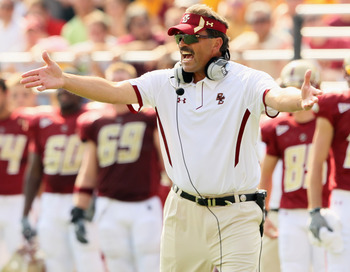
Until the Sandusky news broke Spaz was always quick to remind people of his connection to Penn State and Joe Paterno. His loyalty to the school is one of the reasons BC hasn't poached any Penn State recruit (despite having plenty of potential scholarships). So now as we near the end, I hope Spaz follows his former role model into the coaches booth this season. Do we really need him on the sidelines managing games? He never uses his timeouts. He seems to hate the obligatory halftime interview. The players seem to check out any time he gives a "rah rah" peptalk. I have more faith in Doug Martin and Bill McGovern winning games with Spaz removed from the situation than I do with Spaz involved.
Spaz's protector is gone and he's probably next. I am sure the man has pride and wants to go out on top, but I am not sure he can be a positive influence. I would prefer if like JoePa's final seasons, he was head coach in name only. This works for everyone. Spaz keeps his paycheck and title and yet doesn't put up with the stress or grind of the job.
This season hasn't begun and we are already off to a weird start. Why not go full tilt boogie and go without a head coach? In my mind, it's a win-win that might lead to a few more wins.
Sunday, August 19, 2012
We have no running backs and that's a good thing
We held a situational scrimmage Sunday and are down to one healthy running back. While Spaz's amateur roster management frustrates me to no end, I do think there is a silver lining to the situation. If we are forced to be one dimensional, we might finally use a modern college football offense and actually score some points!
BC has a pocket passing QB and an inconsistent offensive line. It is time for Rettig to be in the shotgun and start flinging the ball quickly. Under three different coordinators Spaz's offenses rarely score more than 20 points. Yet we never open things up. I don't know if it is Spaz's edict or lack of faith in the QBs, but for whatever reason we have not done something most other college teams can. Maybe now that we have an OC that likes to pass, a Junior QB and one legitimate running back, we will finally throw.
What Spaz doesn't seem to understand is that his conservative nature has barely paid off in wins (20-19) and has been beyond boring to watch. BC fans are going to complain after any Spaz loss, so why doe he care if he can keep it close. If we lose to Miami 48-45 and throw it 50+ times, I know fans will gripe, but some of us will welcome the new look and feel.
BC has a pocket passing QB and an inconsistent offensive line. It is time for Rettig to be in the shotgun and start flinging the ball quickly. Under three different coordinators Spaz's offenses rarely score more than 20 points. Yet we never open things up. I don't know if it is Spaz's edict or lack of faith in the QBs, but for whatever reason we have not done something most other college teams can. Maybe now that we have an OC that likes to pass, a Junior QB and one legitimate running back, we will finally throw.
What Spaz doesn't seem to understand is that his conservative nature has barely paid off in wins (20-19) and has been beyond boring to watch. BC fans are going to complain after any Spaz loss, so why doe he care if he can keep it close. If we lose to Miami 48-45 and throw it 50+ times, I know fans will gripe, but some of us will welcome the new look and feel.
Good seats still available
BC heard you. While not everyone complained to the school about Gene, enough fans withheld donations and didn't buy tickets for this upcoming year, that BC got the message. Financial support of the program and ticket sales were significant factors in this change. If you did withhold your money (whether through donations or tickets) because of Gene, now is the time to give. Don't wait for the new AD or for someone to fire Spaz. Removing Gene is enough of a message that the Department is changing. BC needs your financial support and our teams need your fan support. Administrators and coaches come and go, but the players remain BC students and future Boston College alumni. Respect them. Support them. And even if Spaz leads us through another lousy season, you know hope is just around the corner.
BC deserves your money because they just gave you want you've wanted. Supporting BC this fall won't be an endorsement of Spaz. He's done. It would be support of the school's recent actions and its new direction.
These guys are not getting the job
Regular comments poster mod34b asked what I thought of Ed McLaughlin, Jim Paquette and Ken Kavanaugh. Since their names keep popping up on blogs and message boards, I thought I would put their candidacies to rest. All three are supposedly good guys and may be the AD at BC one day, but none are getting the job now.
Ed McLaughlin just got hired by VCU. I don't think BC is going to steal him away after just a few months. I also think his lack of experience dealing with major media or a football program hurts. Although it shouldn't be a factor, I think age will play a role too. Ed is only 39. I think BC will want someone a little more accomplished or experienced with the movers and shakers of college sports media. As I said, Ed could very well be running BC's Athletic Department one day. It won't be this school year though.
Jim Paquette could probably transition to the role with ease. He was one of Gene's right-hand men for years. He knows the coaches, the support staff and most of the big donors. Those attributes are his problems too. BC made the change so they could move on from Gene and rebuild some relationships. That sentiment would come off pretty hollow if BC replaced Gene with one of his key guys.
Ken Kavanaugh is a BC grad and the current Athletic Director at Florida Gulf Coast University. If I just wrote "Kevin Kavanugh is a BU grad and the current Athletic Director at Florida Gulf Coast University" would he even be mentioned? I obviously root for any fellow Eagles, but there is nothing other than his BC affiliation and relationship with Jerry York that makes Kavanaugh a likely candidate. It looks like he is doing good things in leading FGCU to Division I, but BC needs an AD with more football and/or media marketing experience.
Ed McLaughlin just got hired by VCU. I don't think BC is going to steal him away after just a few months. I also think his lack of experience dealing with major media or a football program hurts. Although it shouldn't be a factor, I think age will play a role too. Ed is only 39. I think BC will want someone a little more accomplished or experienced with the movers and shakers of college sports media. As I said, Ed could very well be running BC's Athletic Department one day. It won't be this school year though.
Jim Paquette could probably transition to the role with ease. He was one of Gene's right-hand men for years. He knows the coaches, the support staff and most of the big donors. Those attributes are his problems too. BC made the change so they could move on from Gene and rebuild some relationships. That sentiment would come off pretty hollow if BC replaced Gene with one of his key guys.
Ken Kavanaugh is a BC grad and the current Athletic Director at Florida Gulf Coast University. If I just wrote "Kevin Kavanugh is a BU grad and the current Athletic Director at Florida Gulf Coast University" would he even be mentioned? I obviously root for any fellow Eagles, but there is nothing other than his BC affiliation and relationship with Jerry York that makes Kavanaugh a likely candidate. It looks like he is doing good things in leading FGCU to Division I, but BC needs an AD with more football and/or media marketing experience.
Saturday, August 18, 2012
If BC promotes internally they should look at these two
Although I want BC to look beyond the familiar names, I fear the school's leaders will want someone they know and who can take over the role quickly. If the school heads in that direction, I don't want any current Athletic Department officials. My bias may be unfair, but are any of Gene's lieutenants really capable of changing the culture, rebuilding bridges and bringing new ideas and approaches? But there are two current BC employees who could change our Athletic Department in a positive way.
Warren Zola
Currently the Assistant Dean for Graduate Programs in the Carroll School, Zola worked in the Athletic Departmet in the 1990s. In his current role he has been advising BC student athletes on their professional options and life after sports. Zola also consults other Athletic Departments and is a frequent speaker and writer on sports topics. What I like about Zola is that he's got one foot in the NCAA world, but also has the education and experience beyond the playing field. Zola understand's media and could be a driving force in improving our coverage and making sure the ACC keeps up with other major conferences media revenues.
Lou Imbriano
The trend in college athletic leadership is to hire marketing guys from the business world, instead of just promoting long-time administrators. Fortunately for BC, current marketing professor Lou Imbriano was the Patriots Chief Marketing Officer during their Super Bowl runs and also helped build the marketing department at WEEI in the 1990s. BC needs to boost marketing, fix our ticketing system and begin huge infrastructure projects. Lou's time with the Pats building Gillette Stadium would be especially relevant.
I don't think either guy will get serious traction, but both embody the type of thinking we need.
Warren Zola
Currently the Assistant Dean for Graduate Programs in the Carroll School, Zola worked in the Athletic Departmet in the 1990s. In his current role he has been advising BC student athletes on their professional options and life after sports. Zola also consults other Athletic Departments and is a frequent speaker and writer on sports topics. What I like about Zola is that he's got one foot in the NCAA world, but also has the education and experience beyond the playing field. Zola understand's media and could be a driving force in improving our coverage and making sure the ACC keeps up with other major conferences media revenues.
Lou Imbriano
The trend in college athletic leadership is to hire marketing guys from the business world, instead of just promoting long-time administrators. Fortunately for BC, current marketing professor Lou Imbriano was the Patriots Chief Marketing Officer during their Super Bowl runs and also helped build the marketing department at WEEI in the 1990s. BC needs to boost marketing, fix our ticketing system and begin huge infrastructure projects. Lou's time with the Pats building Gillette Stadium would be especially relevant.
I don't think either guy will get serious traction, but both embody the type of thinking we need.
Friday, August 17, 2012
Irish BC Guys Need Not Apply
Replacing Gene DeFilippo presents a great opportunity for BC. I hope we don't blow it by hiring a "BC guy." There are so many challenges ahead. Narrowing our search only to people who worked at or graduated from BC eliminates too many great candidates. Fans always clamor for the familiar or "one of us" but those sorts of relationships and expectations can also bring a lot of baggage. I also fear that hiring a BC Guy or Gal brings a lot of preconceived notions of what can be accomplished at the school.
I don't want someone who just assumes BC will always be behind the Patriots, Red Sox, Celtics and Bruins because "Boston is a pro sports town."
I don't want someone who will just accept the limitations and roadblocks from our neighbors in Newton, Brighton and Brookline with a shrug or an "it is what it is."
I don't want someone from the Old Boys' Network of Athletic Directors and former BC employees. I understand that this is a relationship business but the schools and the conferences that are making strides are hiring business leaders and forward thinkers. A successful executive can learn about coaching just as easily as a former coach can learn about Marketing, Budgeting and Fund Raising.
I don't want someone who approaches the job with a built in assumption that "I have to win over the BC Wall Street crowd and then get the Football Alumni onboard, and then throw a bone to the internet fans,..." A fresh start with all of the BC factions is important but I want the AD to learn that on his or her own, not because they know that from Gene or from being a member of the BC community.
There are many major projects and decisions ahead for our new Athletic Director. He or she will have to change the Department's attitude towards donors, fans and the media. He or she will have to decide the fates of numerous coaches. And the new AD will have to start multiple major infrastructure projects that Gene has been putting off for the last few years. Gene is leaving for a reason. We don't need one of his acolytes to take over and be a lessor version of Coach Flip. We need someone new and bold and someone who thinks BC can be the best athletic department in the country.
I don't want someone who just assumes BC will always be behind the Patriots, Red Sox, Celtics and Bruins because "Boston is a pro sports town."
I don't want someone who will just accept the limitations and roadblocks from our neighbors in Newton, Brighton and Brookline with a shrug or an "it is what it is."
I don't want someone from the Old Boys' Network of Athletic Directors and former BC employees. I understand that this is a relationship business but the schools and the conferences that are making strides are hiring business leaders and forward thinkers. A successful executive can learn about coaching just as easily as a former coach can learn about Marketing, Budgeting and Fund Raising.
I don't want someone who approaches the job with a built in assumption that "I have to win over the BC Wall Street crowd and then get the Football Alumni onboard, and then throw a bone to the internet fans,..." A fresh start with all of the BC factions is important but I want the AD to learn that on his or her own, not because they know that from Gene or from being a member of the BC community.
There are many major projects and decisions ahead for our new Athletic Director. He or she will have to change the Department's attitude towards donors, fans and the media. He or she will have to decide the fates of numerous coaches. And the new AD will have to start multiple major infrastructure projects that Gene has been putting off for the last few years. Gene is leaving for a reason. We don't need one of his acolytes to take over and be a lessor version of Coach Flip. We need someone new and bold and someone who thinks BC can be the best athletic department in the country.
Spaz now an even lamer Lame Duck

Given his public and private actions, I don't believe Gene DeFilippo had any intention of stepping down now. I believe that he planned to serve as AD for years to come and conclude his reign by hand picking BC's next head football coach. That won't be happening now. BC's actions are clear signal that the school did not want Gene's fingerprints on the next hire. I think it also signals that Spaz's days are numbered.
The role of an Athletic Director is broad, but the biggest issue and focus will always and should always be football. Any new AD worth his or her while will insist on the power to fire or keep Spaz. Firing the already unpopular Spaz will be an easy first step for the new leader. A move like that signals change, wins over the unhappy donors and energizes the marketing of the program.
Even if Spaz pulls out a winning season, I think he's still a goner. His age, his lackluster recruiting and fan apathy are enough justification for some new blood. All the winning or losing will change is how BC packages his departure. If he wins, Spaz will "retire." If he loses, Spaz will be fired.
Gene DeFilippo stepping down

Long-time Boston College Athletic Director is stepping down. Regardless of how you feel about Gene or his recent actions, his total tenure at BC was certainly positive. He ran the Department during some of its most successful times. He loved BC and loved being AD.
John Kane will serve as acting AD. I expect a new, permanent Athletic Director to be named this fall.
There are multiple implications, but for now I will say this is a very good thing. I also thank Gene for his service to BC.
Notre Dame using gimmick helmet, why can't BC?
No team takes themselves more seriously than Notre Dame. If the Irish can allow their uniform to be altered like this for one game, why can't BC? Take a look at what Notre Dame will wear as a special look this fall.
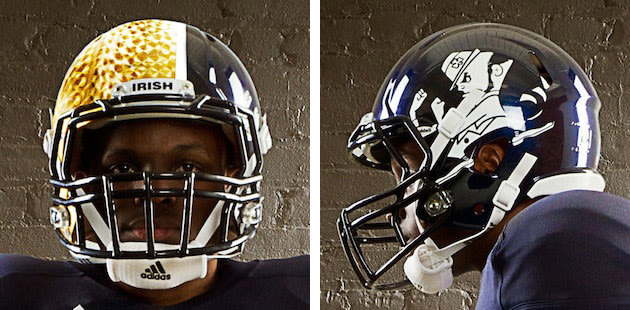
I know we have the white stripe look, but I want to take it a step further. Let's do the wings helmet. The time has come!
Thursday, August 16, 2012
Good news on Finch and other links
Who needs the Boston papers when BC updates the injury status of its star players. I am glad Finch will be back quickly. Now it will be interesting if and when BC makes a coaching change if the twitter account will continue to break news. (Also check out BC's twitter account for great behind the scenes shots of picture day.)
This is a decent and straight forward preview from Yahoo! and it was also written by a BC guy.
More on Marshalls' BC transfers.
BC didn't wait long to backfill its open scholarship. New Jersey WR Charlie Callinan committed Thursday.
This article on new freshman David Dudeck gives good details on the life during BC's summer sessions.
Former Eagle Craig Smith decided to play in Israel. Interesting that the move wasn't about money. Smith is hoping that getting playing time will open eyes in the NBA.
Another preview video
This is a decent and straight forward preview from Yahoo! and it was also written by a BC guy.
More on Marshalls' BC transfers.
BC didn't wait long to backfill its open scholarship. New Jersey WR Charlie Callinan committed Thursday.
This article on new freshman David Dudeck gives good details on the life during BC's summer sessions.
Former Eagle Craig Smith decided to play in Israel. Interesting that the move wasn't about money. Smith is hoping that getting playing time will open eyes in the NBA.
Another preview video
Still no BC coverage in the Globe but Benbow's on the way
The Herald wrote two articles following the team's second scrimmage (St. X feature and notebook). New beat writer Rich Thompson seems to be embracing his assignment and told me he plans to join twitter once the season begins.
Across town things are a little different. The Globe did not send anyone to cover BC's scrimmage. Julian Benbow is scheduled to cover the team this fall. That's encouraging as Julian's BC basketball work has been very good. He's also on twitter and interacts with fans. Maybe Benbow will finally be the guy to unlock the Globe's potential in college football. One good college football feature or article can have a huge reach online. And BC's season is going to be a surprise or a disaster. Either type of year should provide plenty of interesting content.
Wednesday, August 15, 2012
Finch injured, Oline struggles and I am still not worried

Eric Hoffses wrote a good recap of the second scrimmage. Rettig looked decent, but the big news was Duece Finch hurting his leg. (It is way too early to blame the recent spat of leg injuries on the new turf. but we will have to watch for a trend.) Hoffses also mentioned how much the OL struggled. The defensive line backups were even getting penetration.
Even as the players keep dropping, I am not worried about the latest impact. Finch is good, but I have a feeling we will pass more this season. If the carries are fewer, Williams and Kimble can fill the void.
I am frustrated by the offensive line, but not truly worried. If BC does pick up the tempo and Rettig matures, they can cover mistakes up front.
Every team suffers injuries. BC has yet to lose one player that cannot be replaced. We have decent depth all around and I think this season will not be about Finch or Pantale. It will be about Rettig and Spaz.
We only have a few weeks before kickoff. I don't care if by then half the roster is gone, things will still be better than we are now. Bad BC football is still better than no BC football.
Tuesday, August 14, 2012
ALJ wasn't the only bad news and other links
Losing Louis-Jean wasn't the only rough news of the day. BC's highest rated commitment was Tight End Andrew Isaacs. The Connecticut native switched to Maryland. None of this came as a real surprise as Isaacs had hinted at flipping for months. Let's hope Spaz uses the open scholarship to bring in a high impact players.
Matt Ryan is still mentoring Dominique Davis.
CBS named the following guys as potential X Factors.
Matt Ryan is still mentoring Dominique Davis.
CBS named the following guys as potential X Factors.
I am not worried about ALJ's injury
Sophomore Albert Louis-Jean suffered foot injury and will miss several games. Obviously this is not good news, but it is not the end of the world either. ALJ has a lot of potential, but he was just okay last year. I think Asprilla was a better true freshman. I think we'll be fine with Jones, Williams or even moving Noel back to corner. The key to the defense this year will be pressure up front. It won't be about our corners.
I hope ALJ makes a full recovery and comes back better than ever. I also hope that if the recovery is slow, that he redshirts. We've been burned too often with guys coming back too soon.
I hope ALJ makes a full recovery and comes back better than ever. I also hope that if the recovery is slow, that he redshirts. We've been burned too often with guys coming back too soon.
Monday, August 13, 2012
Who will be the next true freshman to make an impact?
It used to be BC redshirted everyone. That was TOB's preferred roster management method. As players have developed faster and as BC's needs have changed, we've started using true freshmen more often the last six seasons. Anthony Castonzo, Montel Harris, Luke Kuechly and Chase Rettig all played important roles in their first seasons. In 2011 many true freshmen played although none had the immediate impact that the four previously mentioned did.
Will 2012 see any newbies break out? I doubt we will see anyone start from Day 1 on the offensive line like Castonzo did. I also think our depth at running back will preclude the use of Craan. Despite Pantale going down, I don't think we'll use true freshmen tight ends. That really leaves the defensive side of the ball and wide receiver as areas where there are plenty of snaps and plenty of opportunity. Here are three guys who have a chance to breakout.
1. Harrison Jackson. I am not reading too much into the first scrimmage. Jackson's chances are based more on Martin's willingness to throw it often. Think of the Logan days. We threw it so often that all sorts of young players got the chance to step up.
2. Karim Zoungrana. Like Jackson he's in a high opportunity position -- WR. Because he enrolled early, Zoungrana also has a leg up on the other true freshmen as far as understanding the offense. Plus, he's old! Born in 1992, he's on average two years older than most of his freshmen teammates (why don't we recruit more Canadians?)
3. Steven Daniels. Although Daniels is trying to break into our deepest position, I like his chances to make an impact. He's essentially had his redshirt year by spending last season in prep school. His St. X teammates Kuechly and Duggan also got on the field early in their BC careers.
Will 2012 see any newbies break out? I doubt we will see anyone start from Day 1 on the offensive line like Castonzo did. I also think our depth at running back will preclude the use of Craan. Despite Pantale going down, I don't think we'll use true freshmen tight ends. That really leaves the defensive side of the ball and wide receiver as areas where there are plenty of snaps and plenty of opportunity. Here are three guys who have a chance to breakout.
1. Harrison Jackson. I am not reading too much into the first scrimmage. Jackson's chances are based more on Martin's willingness to throw it often. Think of the Logan days. We threw it so often that all sorts of young players got the chance to step up.
2. Karim Zoungrana. Like Jackson he's in a high opportunity position -- WR. Because he enrolled early, Zoungrana also has a leg up on the other true freshmen as far as understanding the offense. Plus, he's old! Born in 1992, he's on average two years older than most of his freshmen teammates (why don't we recruit more Canadians?)
3. Steven Daniels. Although Daniels is trying to break into our deepest position, I like his chances to make an impact. He's essentially had his redshirt year by spending last season in prep school. His St. X teammates Kuechly and Duggan also got on the field early in their BC careers.
Sunday, August 12, 2012
Pantale's surgery scheduled for Monday
BC Captain Chris Pantale will undergo surgery Monday to fix the broken bone in his foot. Recovery is scheduled for six to eight weeks. At this point a medical redshirt is unlikely. Pantale redshirted as a freshmen and as we learned with Momah, the NCAA is unwilling to grant sixth years unless the both redshirts are tied and documented to the same medical issue. Let's hope for quick and healthy return.
Team Poster 2012

Here is our 2012 poster. No stars, lots of players and an emphasis on BC's iconic buildings. I like it.
Ignoring the first scrimmage
BC held its first scrimmage of the preseason Saturday. The offense looked shaky at first, some key players sat out and some random players stepped up. In other words, it was the same first scrimmage we've been having since forever. At this point I won't worry. If the offense looks as bad by the fourth scrimmage, then I will worry. Meter, Blauds and the Herald all provided coverage.
Thank you, Bob Ryan
Boston Globe columnist Bob Ryan wrote his last column before his semi-retirement. He had an amazing body of work and covered some of the biggest moments in Boston and sports over the last 44 years. I owe Ryan a debt of gratitude on three fronts. First, as a young sports fan I lived for the Sports Reporters. The nature of how we discuss sports has evolved, but at the time that show was very important in shaping the arguments of the day. I loved Ryan's humor, passion and willingness to put Lupica and Conlin in their respective places. Later as a student broadcaster in the '90s, Ryan was always gracious with us. He would come on the WZBC with little notice, little prompting and answer any question we asked. Sports Media is filled with big egos, many of whom are cynical and dismissive of student reporters. Ryan was the opposite. He always took us seriously. For a guy who had grown up watching him pontificate on sports, talking to him a few years later was always a bit surreal. Finally I want to thank Bob for participating in a Q&A in the early days of this blog. Like my time with student radio, Ryan never questioned my legitimacy nor dismissed me because I was merely a blogger.
Many BC fans complained about his inconsistent stances on BC. They wanted him to be a fan like most of us. While he might not have been a BC cheerleader, Ryan was always very supportive of BC people, including this one.
Many BC fans complained about his inconsistent stances on BC. They wanted him to be a fan like most of us. While he might not have been a BC cheerleader, Ryan was always very supportive of BC people, including this one.
Saturday, August 11, 2012
BC Eagles United launch, Media Day follow up and other links
BC launched a new portal website for their social media called BC Eagles United. Currently it serves as a hub for all of BC's Athletics social media sites and will have games and other rewards opportunities. I don't know if it will take off, but I applaud BC's effort to create a new way to promote BC sports.
Outside of Pantale, Rettig was the main focus of Media Day (Globe and Herald).
Our Brockton DBs have been playing together for five years. Brian Miller and Bobby Vardaro also received coverage from their local paper.
Tom Coughlin and the Jay Fund gave out a college scholarship to a Florida girl. Of course the highlight of her day was meeting Herzy.
Cleveland.com posted a feature on future Eagle Drew Barksdale.
Outside of Pantale, Rettig was the main focus of Media Day (Globe and Herald).
Our Brockton DBs have been playing together for five years. Brian Miller and Bobby Vardaro also received coverage from their local paper.
Tom Coughlin and the Jay Fund gave out a college scholarship to a Florida girl. Of course the highlight of her day was meeting Herzy.
Cleveland.com posted a feature on future Eagle Drew Barksdale.
Friday, August 10, 2012
My post for SI on Spaz and other links
I wrote about Spaz's Hot Seat for SI's Friday roundup.
This is a fair take on BC's gameday experience.
Soaring to Glory has been busy this summer and here is their latest player profile.
CBS covered our key position battles heading into practice.
This is a fair take on BC's gameday experience.
Soaring to Glory has been busy this summer and here is their latest player profile.
CBS covered our key position battles heading into practice.
Pantale news puts damper on Media Day
Media Day is about fluff, a happy outlook and getting to know the players a bit better. Things didn't go according to plan though as BC announced that Senior Captain Chris Pantale broke a bone in his foot and will miss significant time. That's a tough loss out of the gate as Pantale has real potential and was hoping for a breakout season. Supposedly with Martin's scheme, BC can use more WRs in place of TEs, so I don't think it will derail the offense. It is also a chance for Naples to step up.
Spaz later explained that Ramsey and Miller were both dealing with injuries too.
The good news was that the media turned out in force. The Globe even sent someone!
Spaz was in a light-hearted mood and asked for pitches right down the middle.
BC Sports Information Department did a great job tweeting comments, taking pictures and shooting video.
There should be even more news tomorrow. And for those fans going to the open practice, be sure to take pictures and send them along.
Spaz later explained that Ramsey and Miller were both dealing with injuries too.
The good news was that the media turned out in force. The Globe even sent someone!
Spaz was in a light-hearted mood and asked for pitches right down the middle.
BC Sports Information Department did a great job tweeting comments, taking pictures and shooting video.
There should be even more news tomorrow. And for those fans going to the open practice, be sure to take pictures and send them along.
Thursday, August 09, 2012
Will Spaz let Bill McGovern really be Defensive Coordinator?

Spaz's issues with his offensive coordinators are well known. Supposedly Doug Martin will have autonomy and unrestricted play calling. We'll see if it actually becomes a reality. The less discussed coordinator is on the defensive side. Although Bill McGovern's first stint at BC predated Spaz's arrival, the two are tied together in most BC fans' minds. After Gene promoted Spaz, Spaz named McGovern DC. There are times though when McGovern is coordinator in name only. Gameplan preparation and calls within the game still have Spaz's fingerprints. Gossip says that McGovern is frustrated but didn't leave like the other disgruntled staffers because of his ties to the school and hopes of being a head coach somewhere.
I think McGovern was a fantastic linebacker coach and a valuable recruiter. I don't know what to think of him as a DC. We added new wrinkles last year -- including extensive use of a three-man front. But how much of that was McG and how much was Spaz? We'll never know. I hope Spaz learns from the offensive issues and gives McGovern more autonomy. I don't think it can hurt the actually defense and it might improve staff morale.
Linemen now "Blue Collar"
.JPG)
The BC linemen have been sporting these blue work shirts around campus. It's a symbol of the guys being "Blue Collar" and getting back to what made BC lines great. Is it gimmicky? Sure, but at this point I am willing to try anything.
(Thanks to Ryan for the pic.)
Wednesday, August 08, 2012
Filling in for Kuechly and other links
A nice post on Heights and Lows about replacing Kuechly. I agree with the points completely. Luke was great but our defense should still be very good.
There is lots of lost irony in Marshall calling Domenick LeGrande and Okechukwu Okoroha "BC guys." I wish them both the best and I am glad they are getting to play one more season.
BU transfer Jake O'Brien is headed to Temple instead of BC.
ACC Sports posted a Q&A with Emmett Cleary.
Both the men and women's soccer teams begin the season ranked.
There is lots of lost irony in Marshall calling Domenick LeGrande and Okechukwu Okoroha "BC guys." I wish them both the best and I am glad they are getting to play one more season.
BU transfer Jake O'Brien is headed to Temple instead of BC.
ACC Sports posted a Q&A with Emmett Cleary.
Both the men and women's soccer teams begin the season ranked.
The wrong BC Matt talked to Chase Rettig
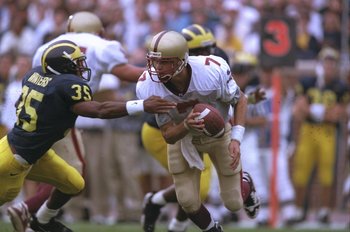 |
| Matt Hasselbeck knows what it is like to lead BC during rough times. |
This offseason Matt Ryan took Chase Rettig to dinner and told him to have fun. I love Matt Ryan but I am not sure he's the former BC QB that should talk to Rettig. Matt Ryan's BC was a very different place. He had one offensive coordinator for his first four seasons. Ryan was grew into his role. Things were good.
Rettig hasn't had that same luxury at Ryan. His redshirt was burned to save the offense in 2010 only to see him get hurt. He came back but the offense still sputtered. Last year due to the staff meltdown, Rettig dealt with two more coordinators. Things haven't been fun and Rettig is being asked to bring BC back and in turn save Spaz's job. If anyone can relate to all this chaos, it is Matt Hasselbeck. He dealt with three BC head coaches in five years. The offense was constantly being tweaked. He took a beating in the pocket while trying to make something happen offensively. He had to lead players and set an example even though the coach had sort of lost the team. Hasselbeck has a tough, smart and hard working player. BC didn't turn around in his Junior or Senior seasons, but how he handled himself earned him a spot in the NFL. Rettig needs to hear about those trials. He's better than his stats or his record but only BC fans know it. A little encouragement from a guy who was also better than his stats or record at BC might make the difference this year and next.
Tuesday, August 07, 2012
Camp begins and Globe still without coverage
The Globe and BC both assured me that the paper would have a dedicated BC beat reporter this year. Well that person has yet to be announced and the paper did not cover the first day of practice. Nothing particularly newsworthy happened, but you would hope that they will begin coverage soon. Fortunately the Herald was there. They reported the most newsy event of the day -- the new captains. Metrowest's Eric Avidon also made an appearance at practice and emphasized the new attitude.
I trust that the Globe will cover the team. I just hope they don't miss the opportunity that the preseason presents. Once the season begins, the beat falls into a fairly structured pattern. Now is the time for the new person to make a mark.
Monday, August 06, 2012
Tessitore feature and other links
SI.com posted a long feature on BC guy Joe Tessitore. Definitely worth the read. Joe is one of ESPN's rising stars and in my opinion the best college play-by-play guy they have. Of course now that BC has Friday night games in our future, Tess has moved on to ESPN's prime Saturday slots.
The players elected Jim Noel, Kaleb Ramsey, Emmett Cleary and Chris Pantale as team captains. Congrats to all of them.
The ACC is playing checkers with TV deals while the other major conferences play chess. This is pretty damning for any remaining Swofford defenders.
Ron Brace is ready for a big year. So is Luke Kuechly. Meanwhile Alex Albright might play both ways this fall. Mark Herzlich will get his shot at starting too.
CBS outlays pretty realistic best and worst case scenarios. I'll post mine closer to the opener.
Reggie Jackson has a chance to break into the Thunder's regular rotation.
The players elected Jim Noel, Kaleb Ramsey, Emmett Cleary and Chris Pantale as team captains. Congrats to all of them.
The ACC is playing checkers with TV deals while the other major conferences play chess. This is pretty damning for any remaining Swofford defenders.
Ron Brace is ready for a big year. So is Luke Kuechly. Meanwhile Alex Albright might play both ways this fall. Mark Herzlich will get his shot at starting too.
CBS outlays pretty realistic best and worst case scenarios. I'll post mine closer to the opener.
Reggie Jackson has a chance to break into the Thunder's regular rotation.
Q&A with author and BC dad Stephen Amidon
When I interact with BC parents, I don't think many of them fully understand our emotional investment in teams their children play on. We're fans (and bloggers) with limited connection to their kids, yet we live and die with their games as if they were family. We glorify their children when they perform well and bluntly criticize the little things when times are rough. After reading his book Something Like the Gods, I think I Stephen Amidon (Alex's father) understands. His book takes a historical look at the evolution of our relationship with athletes. From ancient Greece to today's multimedia jock, Amidon does a very good job of relating our current passions with sports heroes. If you like history and the history of sports, you'll enjoy the book.
With the season approaching and his book available online and in most major bookstores, I asked Amidon a few questions. His answers are below.
ATLeagle: The book has a historical and anthropological tone. Are you that analytical about sports when you are watching as a fan? What are you like on a Saturday in the Parents' Section at Alumni?
Stephen Amidon: I am not analytical at all. In the Parents' Section, I am a nervous wreck who occasionally experiences moments of delirious joy. I try to keep an outwardly calm demeanor, but on the inside things can get pretty hectic. In fact, the intensity of being the father of an athlete is one of the reasons I wrote the book. I wanted to explore exactly why we are so enthralled, captivated, moved and occasionally infuriated by the athlete. Nothing really matches the feeling of being a fan whose home team or favorite competitor is in the midst of a tough contest (even if your son is not out there!). Your daily life is suspended; you are taken to a place where everything is more extreme, more raw. You are totally focused, which is rare in our distracted world. Something Like the Gods is my attempt to analyze and, hopefully, illuminate that experience.
ATLeagle: You write extensively about race and sports. From a personal perspective how prejudicial do you think the leaders in sports are today? For example, your son is a white wide receiver who played high school football at a prep school in Connecticut. Yet his track experience showed that he had speed. If Alex had shown the same raw talent but been black and from Texas do you think he would have been recruited differently? Did most FBS programs assume he was going Ivy League?
Stephen Amidon: Yes, Alexander's experience was pretty unique. Because he went to a prep school that was not primarily known for football (it was traditionally more of a lacrosse/hockey school that does indeed feed into the Ivies), he was not really on many people's radar until he went to a combine in Philadelphia and put up some interesting times and scores. And then he attended the BC camp in the summer before his senior year and that's where he was offered a scholarship. We accepted right away - it felt like a perfect fit at the time and still does. So yes, if he had gone to high school in Texas or Florida, I think the experience would have been very different, a lot busier and more drawn out, fraught with dilemmas and choices. To be honest, I think this is more a question of geography than race. If you live in a big football market, you get more attention. As for racism, from an historical perspective, things are far better than they have ever been. Racial stereotypes still exist, but they tend to be a lot less toxic. You're right - because Alexander is white, people tend to assume he is a possession receiver, when actually he is very fast, and can function as a deep threat for the Eagles. Racial attitudes were a lot worse even in the 1970s, when I played sports. I played JV football in Maryland and was made the starting quarterback over a black player named Michael Anderson, even though he was better than me. But the coaches bought into the ridiculous myth that blacks were in some way ill-equipped to play quarterback. It still makes me cringe to think about. We were 1-9, by the way. Our single victory came when I turned an ankle and Mike played QB.
ATLeagle: I love college sports but I often have to ignore all the corruption, hypocrisy and exploitation that goes into the system. In the book you researched all sports going back to the very first athletes. Did you ever come across a popular sport like college football that unraveled because it didn't police itself well?
Stephen Amidon: I cannot think of any major sport that completely unraveled due to lack of policing, but there are two that came very close. The first is college football in the first decade of the twentieth century, which was almost closed down by President Teddy Roosevelt after an epidemic of on-field deaths. The creation of the Flying Wedge formation a decade earlier meant that helmetless, lightly padded tacklers would often find themselves on the receiving end of five or six crushing blows while trying to get at a runner. The results were truly shocking. Twenty players died in 1904, thirty in 1909. Authorities responded with an ingenious solution - they invented the forward pass, opening up the game and saving it in the process. The second sport that almost ended was Major League Baseball during the 'Black Sox' scandal, in which eight members of the Chicago White Sox, including 'Shoeless' Joe Jackson, were convicted of throwing the 1919 World Series after being bribed by a syndicate of gangsters. In response, baseball owners brought in a tough-minded federal judge, Kenesaw Mountain Landis, to serve as commissioner and clean up the game. Among other things, he instituted a stringent set of anti-gambling rules that are still in effect to this day, as Pete Rose can attest. I think the key in both these cases was that strong, decisive leadership came from political figures outside the leagues to address the crisis. Perhaps there is a lesson here for the NCAA.
With the season approaching and his book available online and in most major bookstores, I asked Amidon a few questions. His answers are below.
ATLeagle: The book has a historical and anthropological tone. Are you that analytical about sports when you are watching as a fan? What are you like on a Saturday in the Parents' Section at Alumni?
Stephen Amidon: I am not analytical at all. In the Parents' Section, I am a nervous wreck who occasionally experiences moments of delirious joy. I try to keep an outwardly calm demeanor, but on the inside things can get pretty hectic. In fact, the intensity of being the father of an athlete is one of the reasons I wrote the book. I wanted to explore exactly why we are so enthralled, captivated, moved and occasionally infuriated by the athlete. Nothing really matches the feeling of being a fan whose home team or favorite competitor is in the midst of a tough contest (even if your son is not out there!). Your daily life is suspended; you are taken to a place where everything is more extreme, more raw. You are totally focused, which is rare in our distracted world. Something Like the Gods is my attempt to analyze and, hopefully, illuminate that experience.
ATLeagle: You write extensively about race and sports. From a personal perspective how prejudicial do you think the leaders in sports are today? For example, your son is a white wide receiver who played high school football at a prep school in Connecticut. Yet his track experience showed that he had speed. If Alex had shown the same raw talent but been black and from Texas do you think he would have been recruited differently? Did most FBS programs assume he was going Ivy League?
Stephen Amidon: Yes, Alexander's experience was pretty unique. Because he went to a prep school that was not primarily known for football (it was traditionally more of a lacrosse/hockey school that does indeed feed into the Ivies), he was not really on many people's radar until he went to a combine in Philadelphia and put up some interesting times and scores. And then he attended the BC camp in the summer before his senior year and that's where he was offered a scholarship. We accepted right away - it felt like a perfect fit at the time and still does. So yes, if he had gone to high school in Texas or Florida, I think the experience would have been very different, a lot busier and more drawn out, fraught with dilemmas and choices. To be honest, I think this is more a question of geography than race. If you live in a big football market, you get more attention. As for racism, from an historical perspective, things are far better than they have ever been. Racial stereotypes still exist, but they tend to be a lot less toxic. You're right - because Alexander is white, people tend to assume he is a possession receiver, when actually he is very fast, and can function as a deep threat for the Eagles. Racial attitudes were a lot worse even in the 1970s, when I played sports. I played JV football in Maryland and was made the starting quarterback over a black player named Michael Anderson, even though he was better than me. But the coaches bought into the ridiculous myth that blacks were in some way ill-equipped to play quarterback. It still makes me cringe to think about. We were 1-9, by the way. Our single victory came when I turned an ankle and Mike played QB.
ATLeagle: I love college sports but I often have to ignore all the corruption, hypocrisy and exploitation that goes into the system. In the book you researched all sports going back to the very first athletes. Did you ever come across a popular sport like college football that unraveled because it didn't police itself well?
Stephen Amidon: I cannot think of any major sport that completely unraveled due to lack of policing, but there are two that came very close. The first is college football in the first decade of the twentieth century, which was almost closed down by President Teddy Roosevelt after an epidemic of on-field deaths. The creation of the Flying Wedge formation a decade earlier meant that helmetless, lightly padded tacklers would often find themselves on the receiving end of five or six crushing blows while trying to get at a runner. The results were truly shocking. Twenty players died in 1904, thirty in 1909. Authorities responded with an ingenious solution - they invented the forward pass, opening up the game and saving it in the process. The second sport that almost ended was Major League Baseball during the 'Black Sox' scandal, in which eight members of the Chicago White Sox, including 'Shoeless' Joe Jackson, were convicted of throwing the 1919 World Series after being bribed by a syndicate of gangsters. In response, baseball owners brought in a tough-minded federal judge, Kenesaw Mountain Landis, to serve as commissioner and clean up the game. Among other things, he instituted a stringent set of anti-gambling rules that are still in effect to this day, as Pete Rose can attest. I think the key in both these cases was that strong, decisive leadership came from political figures outside the leagues to address the crisis. Perhaps there is a lesson here for the NCAA.
Sunday, August 05, 2012
Things I don't want to hear as practice officially starts
Practice begins Monday.The offseason issues we've been dissecting will now get that much more attention locally and nationally. Although I know we will hear about the following endlessly, I hope the media at least tries to come up with something new and avoid the hollow excuses of seasons past.
1. Spaz finally has his guys. This was used as a major excuse last year. If we win this year or lose this year it won't be because of "Spaz's guys." Spaz and his recruiting coordinator have been around for the recruitment of every player on the roster.
2. New vibe around the offense. I like Doug Martin and think he'll be a breath of fresh air. But we won't know what the offense is really like until Miami. Let's not forget the "new" offense and the great feel the players had for Gary Tranquill, Kevin Rogers and Dave Brock.
3. Injuries. We will lose players in practice. Someone will get lost for the season.You know who else will deal with those issues? Every other team in college football.
4. Replacing Luke Kuechly. We will miss him but every college in the country is replacing a great player. Linebacker is our deepest position and the front seven is much improved. Kuechly will be missed but he shouldn't be an excuse for losing.
1. Spaz finally has his guys. This was used as a major excuse last year. If we win this year or lose this year it won't be because of "Spaz's guys." Spaz and his recruiting coordinator have been around for the recruitment of every player on the roster.
2. New vibe around the offense. I like Doug Martin and think he'll be a breath of fresh air. But we won't know what the offense is really like until Miami. Let's not forget the "new" offense and the great feel the players had for Gary Tranquill, Kevin Rogers and Dave Brock.
3. Injuries. We will lose players in practice. Someone will get lost for the season.You know who else will deal with those issues? Every other team in college football.
4. Replacing Luke Kuechly. We will miss him but every college in the country is replacing a great player. Linebacker is our deepest position and the front seven is much improved. Kuechly will be missed but he shouldn't be an excuse for losing.
Saturday, August 04, 2012
Spaz Uncut
Every year at the ACC Media Days, accfootballnews.com plops down a camera at each coach's table and hits record. It's barely edited. What I appreciate about the clips are how the coaches come off in their most natural state. Usually by the time they get to the table interviews they are tired of talking and repeating the same cliches. There are fewer cameras and plenty of tape recorders around but the interactions are much more casual. He's still "on" but for a guy like Spaz you get a better feel for what he can be like in private. Here are the two videos. In the first he mainly discusses Penn State. While Spaz doesn't really say much about Paterno or the NCAA decisions, I am glad he always says the focus should be on the victims.
In this second clip, he's asked about Penn State again, but mostly he talks about improving on last year. Of course he takes a short shot at the bloggers and the twitterers and people on the internet. It's similar to the quip Blauds made this week. This just reinforces what I've told people before: all of these coaches have thin skin and definitely follow what is being said and written. (The only exception to this is Al Skinner, who really didn't follow it.)
Overall Spaz comes across perfectly fine here. He's not embarrassing. He's not exciting. He's Spaz. What else should we expect at this point?
Friday, August 03, 2012
Miami Game point spread and other links
The major sports books released the point spreads for the opening weekend of college football. Miami is currently listed as a 1.5 favorite over BC. I know I've started sipping on the Kool-Aid, but I like BC with the points. We're at home and Miami is rebuilding too.
Another BC target, Orlando WR Jeff Badet committed to USF.
Oprah visited BC (check out the pic of her with Father Leahy). She was there to visit students from her South African Academy. The students are at BC this summer as part of a program to acclimate themselves to U. S. colleges.
BC posted a Q&A with Chase Rettig. Everything he says is encouraging, but I love that Matt Ryan reminded him to just have fun. Fun is one thing that's been lacking from BC football for three years.
This is HD's preview of our summer camp.
The Globe wrote the rare, rare story on a new BC golfer.
Herzy's second year and push to grow his role is one of the big storylines coming out of Giants camp.
Another BC target, Orlando WR Jeff Badet committed to USF.
Oprah visited BC (check out the pic of her with Father Leahy). She was there to visit students from her South African Academy. The students are at BC this summer as part of a program to acclimate themselves to U. S. colleges.
BC posted a Q&A with Chase Rettig. Everything he says is encouraging, but I love that Matt Ryan reminded him to just have fun. Fun is one thing that's been lacking from BC football for three years.
This is HD's preview of our summer camp.
The Globe wrote the rare, rare story on a new BC golfer.
Herzy's second year and push to grow his role is one of the big storylines coming out of Giants camp.
Thursday, August 02, 2012
Key Players for 2012: Tahj Kimble

This is a series on the key players for the 2012 season. Big things are expected for some, while others will need to improve over their previous performances. If 2012 is a good year, it will be in part due to the key players overachieving.
Sophomore Running Back, Tahj Kimble
What he's been: Kimble spent his first season of eligibility as a change of pace back. He only started one game and only ran for 156 yards. Kimble was more valuable as a returner on special teams. Kimble isn't as big as the other running backs but he's shifty and has decent speed. While his stats weren't impressive, his TD catch against Duke was the type of play that makes me think he has potential to be very good.
What he needs to be: We need a play maker. I don't know if Kimble will still be on special teams. I don't know if he will be given a chance to be an every down back. But there should be enough opportunity somewhere for Kimble to make a difference. He can use that potential and help BC's offense break out of its doldrums.
Why I like his chance to shine: Maybe I am grasping at straws or playing too much on the Logan-Martin connection, but I see Martin using Kimble like Logan used Andre Callender. With Logan, Callender became one of BC's best pass catching running backs. Using a RB in the passing game has been nonexistent since Logan left. It's a shame since it can be a great outlet for a maturing QB. If Martin is true to form and wants to shake up the offense, he will throw the ball to Kimble. And once he's established as a threat, that will open up other things around the field.
Most of the players I'm counting on are upperclassmen. But the odds say some of the younger guys will have big seasons too. I think Kimble could be one of those guys. The key will be his maturity and Martin finding a way to get him the ball.
Wednesday, August 01, 2012
Blauds leaves Globe, Globe to begin covering BC
I didn't intend to post about Mark Blaudschun leaving the Boston Globe. But then he wrote this on his new blog:
Blauds took over the BC beat in 2007. Prior to that he had been the Globe's national college writer. I don't know all the union politics of a big city paper, but from what I understand when the Globe eliminated the "national" college beat, Blauds was demoted/transferred back to BC. Maybe he was bitter about it. I don't know as I never talked to him about it. But he clearly didn't care much for the job, his readers or respect the team he was covering. Even now on his blog, he is still positioning BC as a second class citizen in college football. BC has its limitations and no team is perfect, but that doesn't mean that they deserved second class coverage nor third-class reporting. Blauds only broke news when it fell in his lap. Most of the time he was pushing out his dated, out of touch opinions on college sports. We all have our biases but his transparent pimping of the Big East partyline and his protection of Spaz was pathetic.
Blauds unwillingness to write in the offseason or embrace new media like his fellow college writers was a waste of a soap box. Despite the changing landscape, writing for the Globe still carries weight. Blauds never appreciated that. He can scoff at the BC websites but collectively we were producing ten times more content than he ever did.
It appears he's now going independent on his own blog. Maybe he'll finally understand how the world has changed. Maybe he'll realize on the web you have to build an audience. Maybe he'll understand that you have to defend your outlandish statements and you don't have editors back in the main office to clean up after you.
He started his blog with an interview with Mike Tranghese and a post defending Spaz. So it doesn't look like he will be changing his stripes.
I can't wait to see who the Globe assigns. Hopefully he or she will appreciate the job and do some interesting things with the opportunity.
The crap that comes out of the websites about Spaz and the Eagles is mind boggling.First, before I bury Blauds, let me share that both BC and the Globe confirmed to me that the paper/website will assign a new reporter to the BC beat. I encourage anyone with a passion for sports writing, an inkling of talent and the desire to take advantage of all the BC beat and the Boston Globe has to offer to apply. If you bring any talent or passion to the job you will be better than Blauds.
Blauds took over the BC beat in 2007. Prior to that he had been the Globe's national college writer. I don't know all the union politics of a big city paper, but from what I understand when the Globe eliminated the "national" college beat, Blauds was demoted/transferred back to BC. Maybe he was bitter about it. I don't know as I never talked to him about it. But he clearly didn't care much for the job, his readers or respect the team he was covering. Even now on his blog, he is still positioning BC as a second class citizen in college football. BC has its limitations and no team is perfect, but that doesn't mean that they deserved second class coverage nor third-class reporting. Blauds only broke news when it fell in his lap. Most of the time he was pushing out his dated, out of touch opinions on college sports. We all have our biases but his transparent pimping of the Big East partyline and his protection of Spaz was pathetic.
Blauds unwillingness to write in the offseason or embrace new media like his fellow college writers was a waste of a soap box. Despite the changing landscape, writing for the Globe still carries weight. Blauds never appreciated that. He can scoff at the BC websites but collectively we were producing ten times more content than he ever did.
It appears he's now going independent on his own blog. Maybe he'll finally understand how the world has changed. Maybe he'll realize on the web you have to build an audience. Maybe he'll understand that you have to defend your outlandish statements and you don't have editors back in the main office to clean up after you.
He started his blog with an interview with Mike Tranghese and a post defending Spaz. So it doesn't look like he will be changing his stripes.
I can't wait to see who the Globe assigns. Hopefully he or she will appreciate the job and do some interesting things with the opportunity.
Subscribe to:
Posts (Atom)

 Posts
Posts

